
Lithium battery charging and protection integrated circuit board measuring 2.6cm by 1.7cm, providing stable 5V input with a 1000mA maximum charging current and 3A overcurrent protection for safe power management.
Blue
£5.98
Skip to product information

 This integrated circuit board provides a complete solution for managing single-cell lithium-ion or lithium-polymer batteries. It combines a dedicated charging controller with essential protection circuits on a compact 26mm by 17mm PCB. The module accepts a common 5V USB or adapter input, delivering a controlled charge up to 1000mA before automatically stopping at 4.2V. It also safeguards your battery and project by cutting power if discharge voltage falls too low or if current exceeds 3 amps, making it a reliable foundation for portable electronics, DIY projects, or battery backup systems.
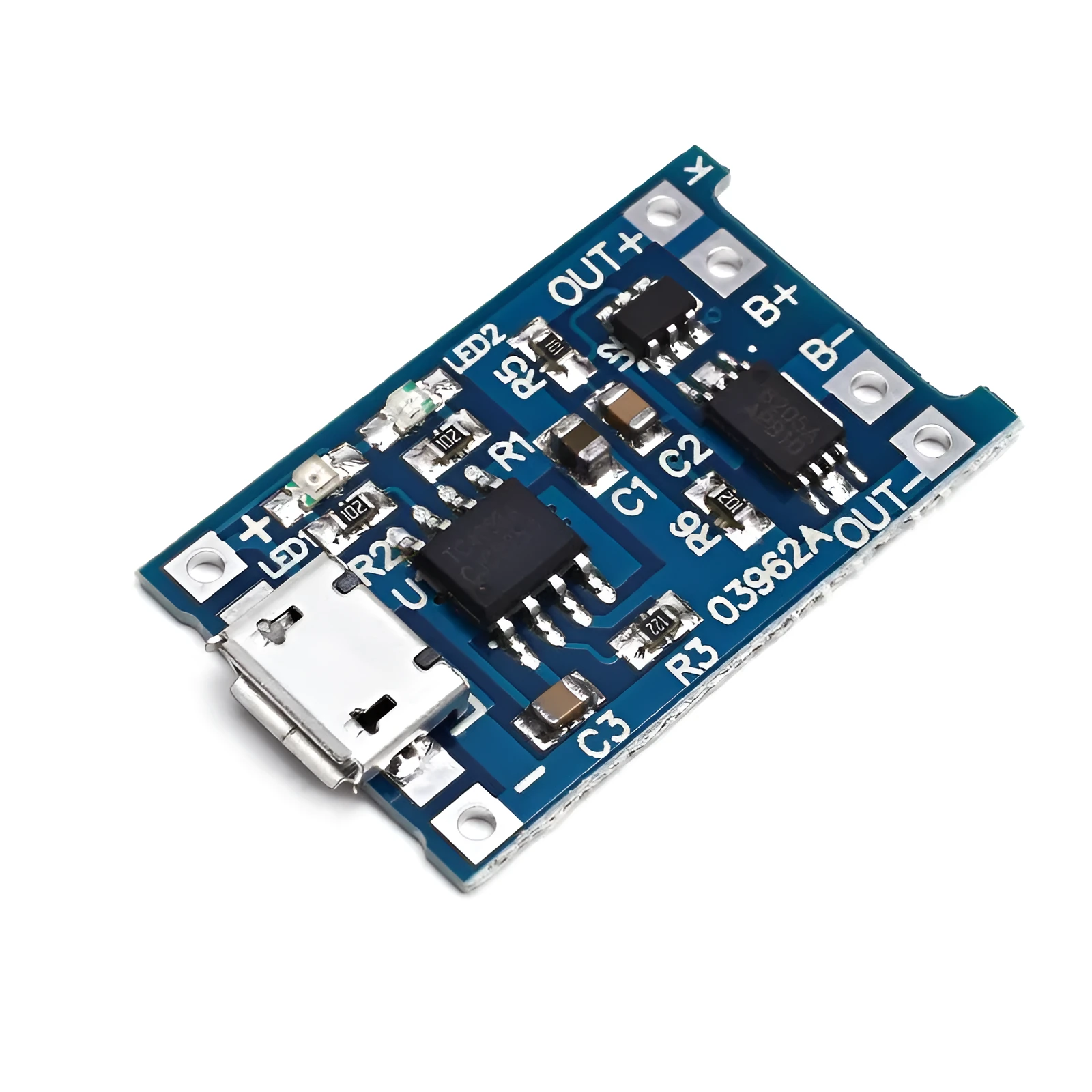 This section details the precise electrical characteristics and physical construction of the lithium battery management board. Every specification is derived from the integrated controller IC and PCB design to ensure reliable performance in your application.
 The integrated design of this board makes it suitable for a wide range of applications where a single lithium cell needs reliable power management. Its compact size is a key advantage for fitting into finished products or prototypes.
 Choosing this integrated board offers distinct advantages over sourcing individual components or using unprotected battery connections. The benefits translate directly into project reliability, safety, and cost-effectiveness over time.


Lithium battery charging and protection integrated circuit board measuring 2.6cm by 1.7cm, providing stable 5V input with a 1000mA maximum charging current and 3A overcurrent protection for safe power management.
£5.98
Lithium Battery Charging and Protection Board with 5V Input and 3A Overcurrent Safety
Features and Technical Specifications
Charging Circuit Design
The board's core function is governed by a charging IC that regulates power from a 5V DC source. It employs a constant-current/constant-voltage (CC/CV) charging algorithm, delivering up to 1000mA of current until the battery reaches 4.2 volts. Charging terminates with a high degree of accuracy, within a ±1% tolerance of the 4.2V target. This precise cut-off is critical for lithium chemistry, as it helps maximise each charge cycle's capacity while preventing the stress and potential damage caused by overcharging.Protection Circuitry Performance
Beyond charging, the integrated protection features activate during discharge. The board continuously monitors the battery voltage. If it detects the voltage has dropped to 2.5V, it will disconnect the load to prevent a harmful deep discharge, which can permanently reduce a battery's capacity. Simultaneously, a separate circuit monitors the current flowing to the connected device. Should this current reach or exceed 3.0 amps—due to a fault or excessive demand—the protection will trigger, breaking the circuit to protect both the battery and your components from potential overheating or damage.Board Construction and Quality
The circuit is printed on a standard 1.6mm thick FR-4 fibreglass substrate, known for its durability and stable electrical properties. A blue solder mask is applied over the copper traces, providing insulation and corrosion resistance while offering high contrast for easier soldering and inspection. All components, including the main controller IC, resistors, and capacitors, are surface-mount devices (SMD) soldered directly to the board. This construction results in a robust, single-sided module ready for integration into a larger project or enclosure.Practical Applications and Uses
Professional and DIY Electronics
For electronics enthusiasts, makers, and small-scale product developers, this board eliminates the need to design separate charging and protection circuits from scratch. It can be directly incorporated into prototypes for smart home sensors, portable data loggers, or custom LED lighting systems. The predefined 3A overcurrent protection simplifies safety compliance for low-power devices, allowing developers to focus on their core application logic rather than power management complexities.Everyday Consumer Projects
Hobbyists will find this module invaluable for upgrading or creating battery-powered gadgets. Imagine converting an old cordless device to use a modern 18650 battery, or building a custom power bank. The board provides a reassuring sense of security; the knowledge that the battery is being charged correctly and is protected from dangerous faults comes from the specific 4.2V cut-off and 3A current limit. The tactile process of soldering wires to the clearly labelled pads on the blue board makes for a satisfying and educational build.Versatility in Power Solutions
While designed for single-cell use, its output can power a diverse array of 3.7V nominal devices. It can serve as the brain for a wireless security camera's battery pack, a handheld gaming device mod, or an emergency USB charger. Its 5V input compatibility means it can be charged from ubiquitous USB ports, wall adapters, or even solar panels with a 5V regulator. The board's versatility lies in this combination of standard interfaces and robust protection, making it a adaptable component for countless power-related projects.Key Benefits and Long-Term Value